If you’re looking for a digital marketing for beginners roadmap, this is the approach I wish someone had shared with me when I was starting. I was like a new person. I did what they do. I opened a lot of tabs on my computer, around 20 of them. I also saved a bunch of YouTube playlists, a dozen. Then I tried to learn a lot of things all at once, like SEO and social media and paid ads and email marketing. I was trying to learn SEO and social media and paid ads and email marketing all at the time, which was a lot to take in. It felt productive. I was “learning” every single day.
I wasn’t actually getting better at anything.
It took me months of scattered effort to realize the problem wasn’t my work ethic – it was my approach. When I finally stopped trying to learn everything and focused on one thing, that was when things really started to happen. The thing I chose to focus on was SEO. Building my website using SEO was a really great idea. I learned much more about SEO in just a few months than I did from all the other tutorials I had done before that.
Digital Marketing for Beginners: Start With the Big Picture
Before you touch any tool, spend a short amount of time understanding what digital marketing for beginners involves SEO, content, social media, paid ads, email, analytics, and how these pieces connect. You do not need to be an expert on this map. It is just good to know that the map is available so you can decide where to begin. The map is something you should be aware of when you’re trying to figure out where to start with the map.
Here is the part that most beginners ignore. After that introduction, choose one area. Stay with it. Not two. Not “Social media at the same time.”
I chose Search Engine Optimization mainly because I wanted to understand how search engines decide what to display to users. It turned out that being curious was more important than choosing Search Engine Optimization. You should choose something that really interests you because you will need that interest to get through the parts that’re not so interesting later.
Why This Matters More Than It Sounds
Digital marketing for beginners can feel overwhelming because the field is broad enough that shallow knowledge across five areas leaves you unable to actually execute anything well. I figured this out the way. I was jumping around between SEO tutorials. Paid ads and email marketing tutorials. This really left me with bits of information and no actual skill, with SEO or paid ads, or email marketing.
If you focus on one thing, like SEO or paid ads or email marketing for a month, you will get a good foundation. You will not get this foundation if you try to learn a bit about SEO and paid ads and email marketing all at the same time.For Digital Marketing for Beginners, focusing on one skill at a time is a much better approach than trying to learn everything at once.
Learn the Fundamentals – Then Immediately Apply Them
Once I picked SEO, I didn’t just keep consuming content. When you’re learning digital marketing as a beginner, this is where the real learning starts. I moved into keyword research, search intent, and content optimization – and I made sure each concept got used, not just understood.
This is one of the most important lessons in Digital Marketing for Beginners: learning and doing should never be treated as separate phases.
This is the step people get wrong: they treat learning and doing as separate phases. “First I’ll learn SEO for three months, then I’ll practice.” That’s backwards. The moment you learn what a keyword is, go find one. The moment you learn what search intent means, analyze it for a real query. Theory without immediate application evaporates.
Build Something Real – This Is Where It Clicks
If you’re a beginner learning digital marketing right now, stop waiting until you “know enough” to start a project.
The single biggest turning point in my digital marketing for beginners journey wasn’t a course or a certification. It was building my website from scratch.
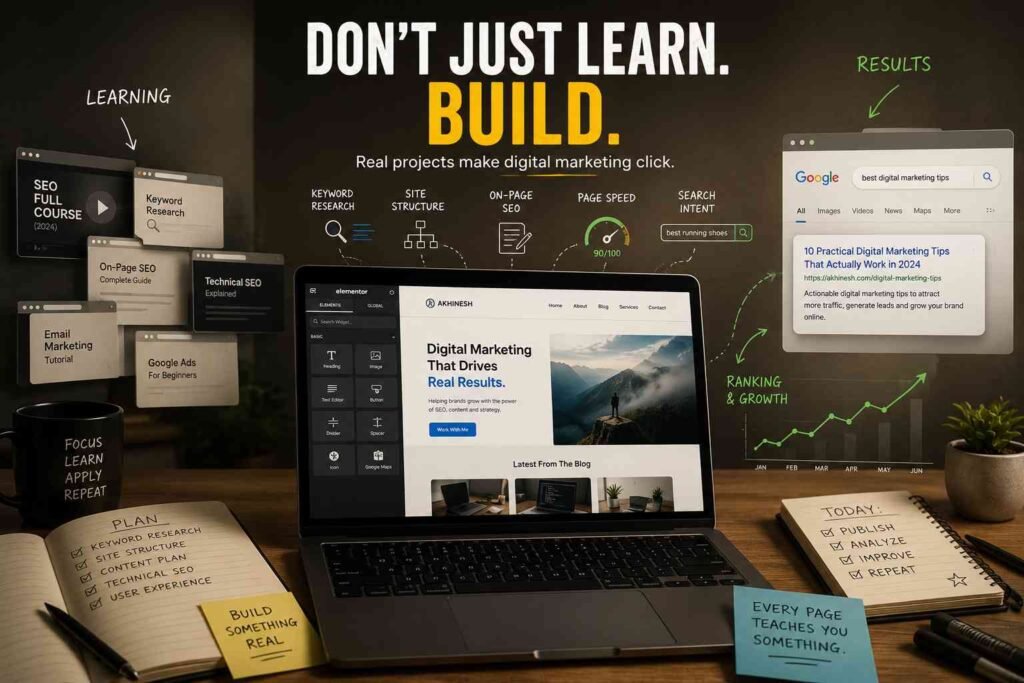
I did the keyword research to see what people were looking for on the internet. I planned the site structure around that research. I made content that’s good for search engines. The titles are clear. The descriptions that people see in search results are correct. I fixed the links on the website so the website links work properly. The website needs to be found by search engines like Google. So I made sure the website content is good for the search engines.
I checked the website links to make sure they work.
The website also needs to load. I worked on making the website load faster so people can see the website quickly. I want the search engines to find my website easily. I tried to make it easier for people to use the website. I did all of this to improve the user experience and the page speed of the website.
Nothing ranked overnight. That wasn’t the win. The win was that every single page I published or optimized taught me something new about how search intent, content structure, and technical SEO actually interact in practice – not in a tutorial’s simplified example, but in a real, messy website with real constraints.
If you’re learning digital marketing right now, stop waiting until you “know enough” to start a project. Start the project. The gaps in your knowledge will show up naturally. You will fill these gaps in your knowledge because you need to. This is not because a course told you to fill the gaps in your knowledge. You will do it because the gaps in your knowledge are important to you.
One Skill Naturally Pulls in the Next
Here’s something I didn’t expect: I didn’t sit down and decide to learn WordPress, Elementor, technical SEO, page speed optimization, Google Search Console, and Google Analytics. For beginners learning digital marketing, each skill became necessary because of the project I was working on. Building the website required each of these, one after another, in a logical order.
- Needed a website → learned WordPress and Elementor
- Wanted it to rank → learned technical SEO and page speed
- Wanted to know if it was working → learned Search Console and Analytics
This is the real shape of the roadmap for Digital Marketing for Beginners: you don’t need to plan every skill. Real projects generate the next skill you need, That’s a better way than trying to plan out all of the lessons before you have done anything yet.
Only after I felt really good about those basics did I begin to look at media marketing, paid ads, and bigger plans, and by that point I had enough real experience to see if those methods worked for the kind of work I wanted to do.
The Misconception That Changed How I Work
It does not work like that. A nice website that no one can find through search is just like it isn’t there. Once I realized that, my whole way of thinking about search engine optimization and content strategy changed. I stopped asking if the website looks good and started asking if the search engine optimization will help the right person find what they are looking for on the website.
That single question about the search engine optimization and content strategy reframes every decision in the search engine optimization and content strategy, from how you structure a webpage to what you write about on the website in the first place. This is an important lesson for anyone learning Digital Marketing for Beginners: The search engine optimization and content strategy also reveal that digital marketing is not about hacks or overnight wins.
Digital marketing is about solving a real problem for a real searcher who is looking for something on the website and improving that solution to the problem over time with the search engine optimization and content strategy.
The Roadmap, Summarized
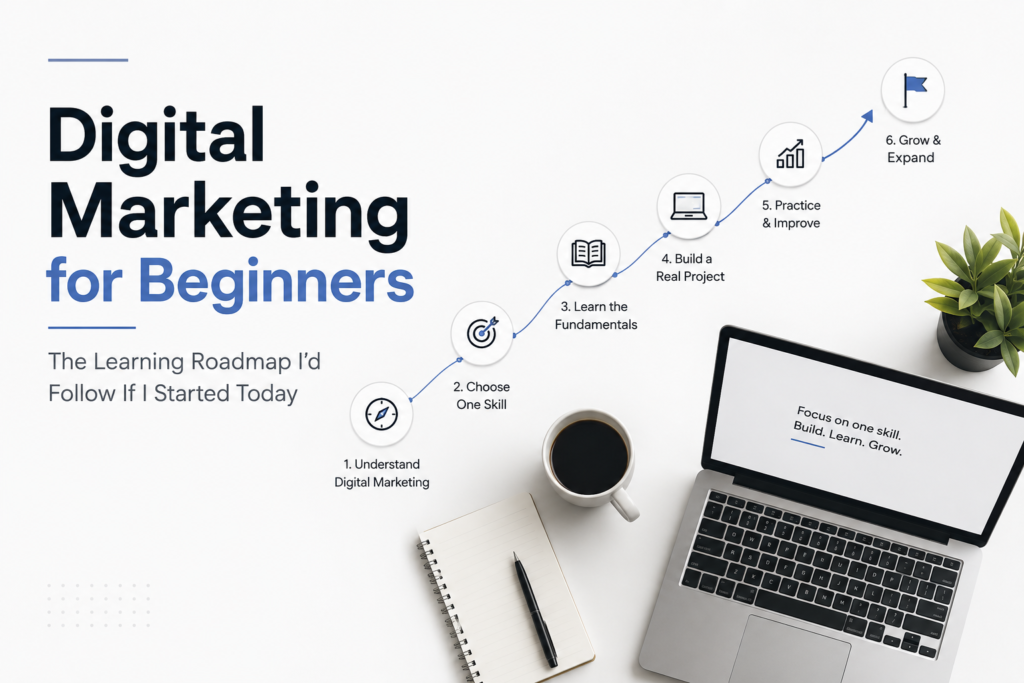
If you’re starting your digital marketing journey today, here’s the roadmap I’d actually follow as a beginner:
Get a rough map of digital marketing – just enough to make an informed choice, not a deep dive.
- Pick one skill. Stick with it. Stay focused. Resist the urge to do everything all at once.
- Master the basics and use them away. Never keep learning and doing separate.
- Build a real project – a website, a small campaign, anything with real stakes.
- Let the project teach you the next skill – don’t over-plan your curriculum.
- Only then branch out – into social, paid ads, or other channels, once your fundamentals are solid. This is the approach I recommend for Digital Marketing for Beginners.
Common Questions Beginners Ask
Do I need to learn every area of digital marketing as a beginner? No – Digital Marketing for Beginners doesn’t mean learning everything at once. Pick something you really want to be good at. This is the thing that you will work on. You will work hard to get really good at this thing. You have to put in a lot of effort to be good at this thing. The thing you choose is what you will focus on. So choose something you really want to be good at. Then you will work hard to get really good at this thing.
How long do you think you should keep working on one thing before you try something? Well, there is no time limit for this. You will know it is time to move on to something when you feel okay with the basics of that thing. This is not because of a date on the calendar but because you will feel like you have a good understanding of that thing.
I spent a month learning about SEO and building websites. I did this because I wanted to understand SEO. I did this because I wanted to understand SEO not just because I was following some plan. Not just because I was following some plan. I wanted to make sure I knew how SEO works.
I wanted to make sure I knew how SEO works. So I took my time to learn about SEO. So I took my time to learn about SEO. I built websites before I moved on to other things. I built websites before I moved on to other things. This is an important part of learning Digital Marketing for Beginners.
Do you really have to create a website to understand SEO? I do not believe it is the way to do it. It worked well for me. When you have a website, you have to apply the things you learn about keywords, how to arrange your content, and how to improve your website. This is something that simply reading about it or watching videos cannot do for you. Having a website makes you actually do these things, and that is how you learn about Search Engine Optimization. For Digital Marketing for Beginners, this kind of hands-on practice can make the learning process much more effective.
The Bottom Line
The plan that really works isn’t a list of classes to take. It’s this approach: choose one skill (if you’re unsure where to begin, start with my SEO for Beginners guide), learn enough to begin using it, create something real based on it, and let that project show you what you need to learn next. Everything else – the tools, the additional channels, the broader strategy – comes easier once that foundation is in place. That’s the foundation of Digital Marketing for Beginners.